
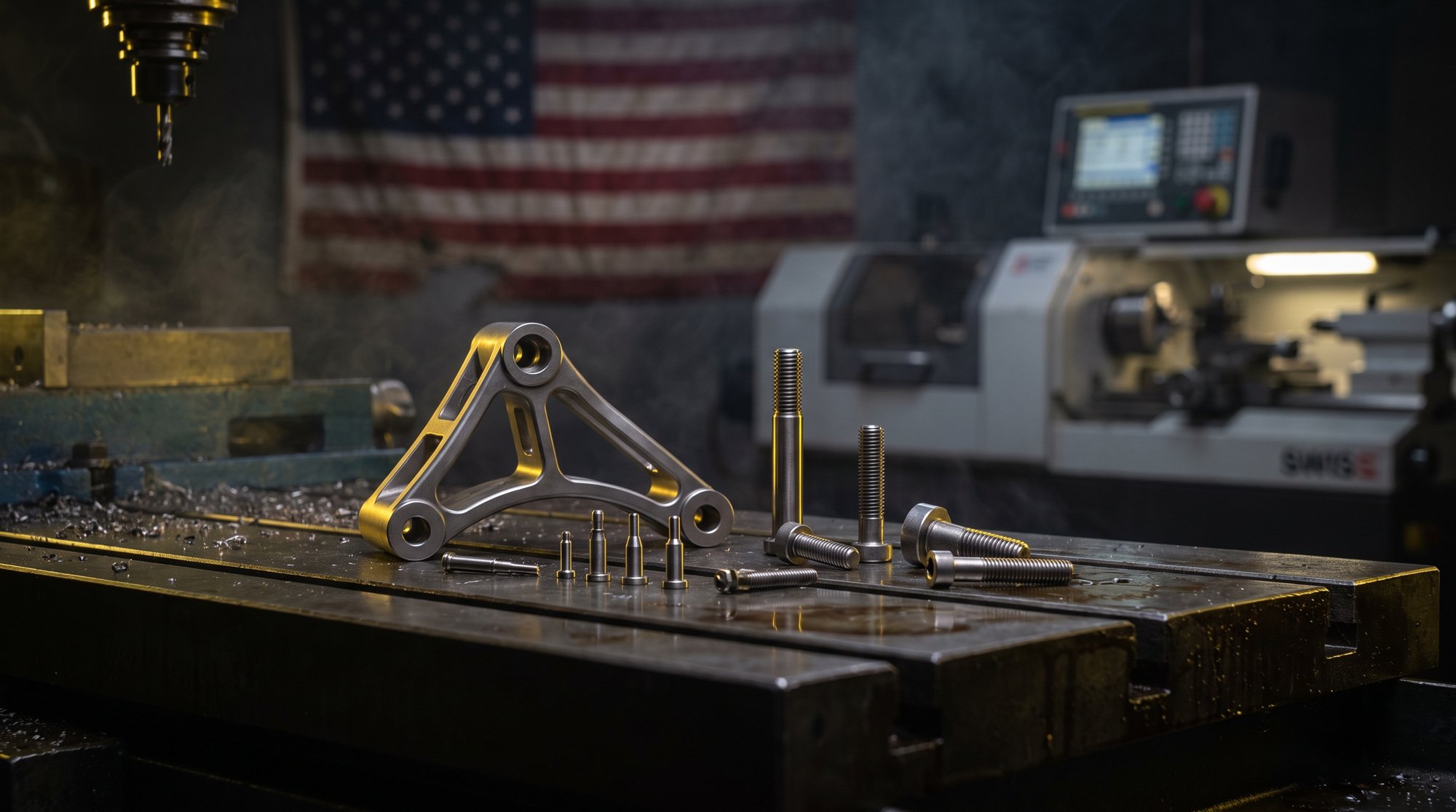
Aerospace and defense buyers are pulling programs back to U.S. soil. The reasons are stacking up fast — stricter ITAR enforcement, active federal reshoring policy, and a global supply chain that continues to strain program schedules through 2027 and beyond. For buyers sourcing precision-machined parts, offshore is no longer the low-risk option it once looked like. This shift has real numbers behind it, and understanding them helps program managers make the case for domestic sourcing before the next audit, delay, or compliance event forces the decision anyway.
The Real Cost of ITAR Non-Compliance in 2026
The Directorate of Defense Trade Controls (DDTC) enforces the International Traffic in Arms Regulations, and the current numbers are not small. The current ITAR civil penalty is $1,271,078 per violation, or twice the value of the transaction, whichever is greater. Criminal penalties add another layer — up to $1 million per violation and 20 years of imprisonment under 22 CFR Parts 120 through 130.
These are not theoretical numbers. In October 2024, Raytheon agreed to pay over $950 million to resolve multiple U.S. government investigations including violations of the Arms Export Control Act and ITAR. That settlement remains one of the largest ITAR-related resolutions on record. Enforcement is not slowing. In September 2025, DDTC issued USML revisions across 14 categories, tightening control over defense articles and technical data.
For aerospace buyers, this shift matters because ITAR treats the release of controlled technical data to foreign persons as a deemed export — even if the data never leaves the country physically. Sending a controlled drawing to an overseas Swiss shop, a foreign engineer, or a cloud platform outside the U.S. can trigger a violation without a single shipment crossing a border. Domestic suppliers with ITAR registration and secure data handling remove that exposure. Buyers moving programs back to U.S. shops cite this risk more often than any other in current reshoring discussions.
Federal Policy Now Actively Pushes Reshoring
Reshoring is not just a market response. It is federal policy. The FY2026 National Defense Authorization Act includes expanded reshoring support for the defense industrial base, funding domestic manufacturing capacity for critical components. Congress has treated dependence on offshore suppliers as a strategic risk since the pandemic, and the funding follows that framing.
The Cybersecurity Maturity Model Certification program adds another push. CMMC Phase 2 begins November 10, 2026, requiring new solicitations for contracts involving Controlled Unclassified Information to include third-party C3PAO assessments. Contractors without certification cannot bid on affected contracts. That deadline is close enough that buyers currently sourcing offshore face a real timing problem — offshore suppliers rarely hold U.S. cybersecurity certifications, and qualifying a new domestic supplier from scratch takes months.
Meanwhile, the DDTC finalized the AUKUS defense trade exemption on December 30, 2025, under §126.7(c). While the exemption streamlines defense trade among the U.S., U.K., and Australia, it also underscores how tightly the U.S. continues to control everything outside that narrow trusted circle. For most other countries, the compliance burden on U.S. buyers has grown, not shrunk.
Supply Chain Fragility Isn’t Ending in 2026
The offshore case rested for years on cost. That case has weakened as supply chain volatility compounded. According to the Deloitte 2026 Aerospace & Defense Industry Outlook, persistent shortages of materials, skilled labor, and geopolitical disruptions are keeping the sector’s supply chain under pressure through at least 2027. The commercial aircraft backlog now exceeds 17,000 aircraft — roughly 12 years of production at current rates, per IATA.
Delivery shortfalls total at least 5,300 aircraft. According to a joint study by IATA and Oliver Wyman, supply chain bottlenecks cost the airline industry more than $11 billion in a single year. Boeing incurred an estimated $5 billion in losses tied to halted production and delivery delays, per Leeham News reporting from May 2026. These are not blips. They are structural, and offshore suppliers sitting in fragile tariff regimes or contested shipping lanes multiply the risk instead of reducing it.
The skilled labor problem crosses borders. According to an Aerospace Industries Association study cited across current industry reporting, 56% of companies are struggling to hire skilled manufacturing workers. Offshore was supposed to solve this. Instead, offshore capacity is often just as constrained, and the delay stacks up on top of shipping time, customs delays, and compliance review.
What Aerospace Buyers Look For in a Domestic Supplier
Buyers moving programs back to the U.S. are not just chasing a lower risk profile. They are looking for specific credentials, and the bar has moved up.
- AS9100 and ISO 9001:2015 certification — the aerospace quality management standard published by SAE, built on top of ISO 9001 with over 100 additional aerospace requirements
- ITAR registration — required for any U.S. person who manufactures defense articles, per 22 CFR
- JCP (DD2345) certification — proves the supplier can handle controlled unclassified information and militarily critical technical data
- Published tolerances and equipment specs — buyers want capability data upfront, not vague marketing claims
- Full traceability paperwork on every batch — material certs, inspection reports, and part-level tracking that survive a prime’s audit
The suppliers who check every box get invited to bid on the reshored work. The ones missing any box get filtered out before the RFQ arrives. That filtering has intensified alongside enforcement.
How EGM Manufacturing Fits the Domestic Compliance Playbook
EGM Manufacturing is an AS9100 certification holder and an ISO 9001:2015 certified quality system. We are ITAR registered and hold a JCP Certification (DD2345), which authorizes us to receive and process controlled unclassified information and defense-related technical data. Our shop in Sunrise, Florida runs Tsugami B0386-III and B0205-V Swiss lathes alongside our multi-axis milling and CNC turning platforms, backed by 50+ years of combined machining experience.
For buyers reshoring programs from offshore suppliers, that credential stack removes the compliance risk that made offshore untenable. Every part ships with inspection reports, material certifications, and full traceability. Controlled drawings run through secure systems with access limited to cleared staff.
Frequently Asked Questions About Reshoring Precision Machining
What is the current civil penalty for an ITAR violation?
The current ITAR civil penalty is $1,271,078 per violation, or twice the value of the transaction, whichever is greater, per the Federal Register 2024 Civil Monetary Penalties Adjustment. Criminal penalties can reach $1 million per violation plus up to 20 years of imprisonment under 22 CFR Parts 120 through 130.
Does ITAR prohibit outsourcing to non-U.S. shops?
Not outright, but ITAR treats the release of controlled technical data to foreign persons as a deemed export requiring prior license authorization. In practice, most defense-controlled programs stay domestic because obtaining and maintaining export licenses for every controlled drawing sent overseas creates cost, delay, and compliance risk that outweighs any offshore price advantage.
What is CMMC and when does Phase 2 start?
The Cybersecurity Maturity Model Certification program governs how defense contractors handle Controlled Unclassified Information. CMMC Phase 2 begins November 10, 2026, requiring new solicitations for CUI-related contracts to include third-party C3PAO assessments. Contractors without certification cannot bid on those affected contracts once Phase 2 takes effect.
What certifications should a reshoring supplier hold?
Aerospace and defense buyers typically require AS9100 and ISO 9001:2015 certification, ITAR registration through DDTC, and JCP (DD2345) certification for controlled technical data handling. Buyers running CUI-marked programs also confirm CMMC readiness. Missing any one of these certifications usually filters a supplier out of the RFQ list before quoting begins.
How long does it take to qualify a new domestic supplier?
Qualification timelines vary by program and prime. Simple parts on lower-risk programs can qualify in weeks. Flight-critical or ITAR-controlled parts often require months of documentation review, first-article inspection, and audit. Buyers reshoring programs are starting qualification early, sometimes 6 to 12 months ahead of the offshore contract’s expiration date, to avoid delivery gaps.
What is the FY2026 NDAA reshoring support?
The FY2026 National Defense Authorization Act includes expanded provisions supporting the domestic defense industrial base, including reshoring funding for critical component manufacturing. The specific programs and dollar amounts vary by title, but the direction is clear — Congress continues to prioritize domestic capacity over offshore sourcing for defense-related components.
Can EGM Manufacturing take on ITAR-controlled programs?
Yes. EGM Manufacturing is ITAR registered and holds a JCP Certification (DD2345), which authorizes us to receive and process controlled unclassified information and defense-related technical data. All ITAR drawings run through secure systems with access limited to cleared staff. Please contact our team before transmitting any controlled package so we can confirm the receiving path.
Ready to Move Your Program Home?
Reshoring precision machining is no longer just a compliance decision. It is a schedule decision, a risk decision, and increasingly a cost decision. EGM Manufacturing brings the certifications, the equipment, and the track record aerospace and defense buyers need for programs that cannot afford another offshore delay or compliance event.
Contact Us Today to Get Started