
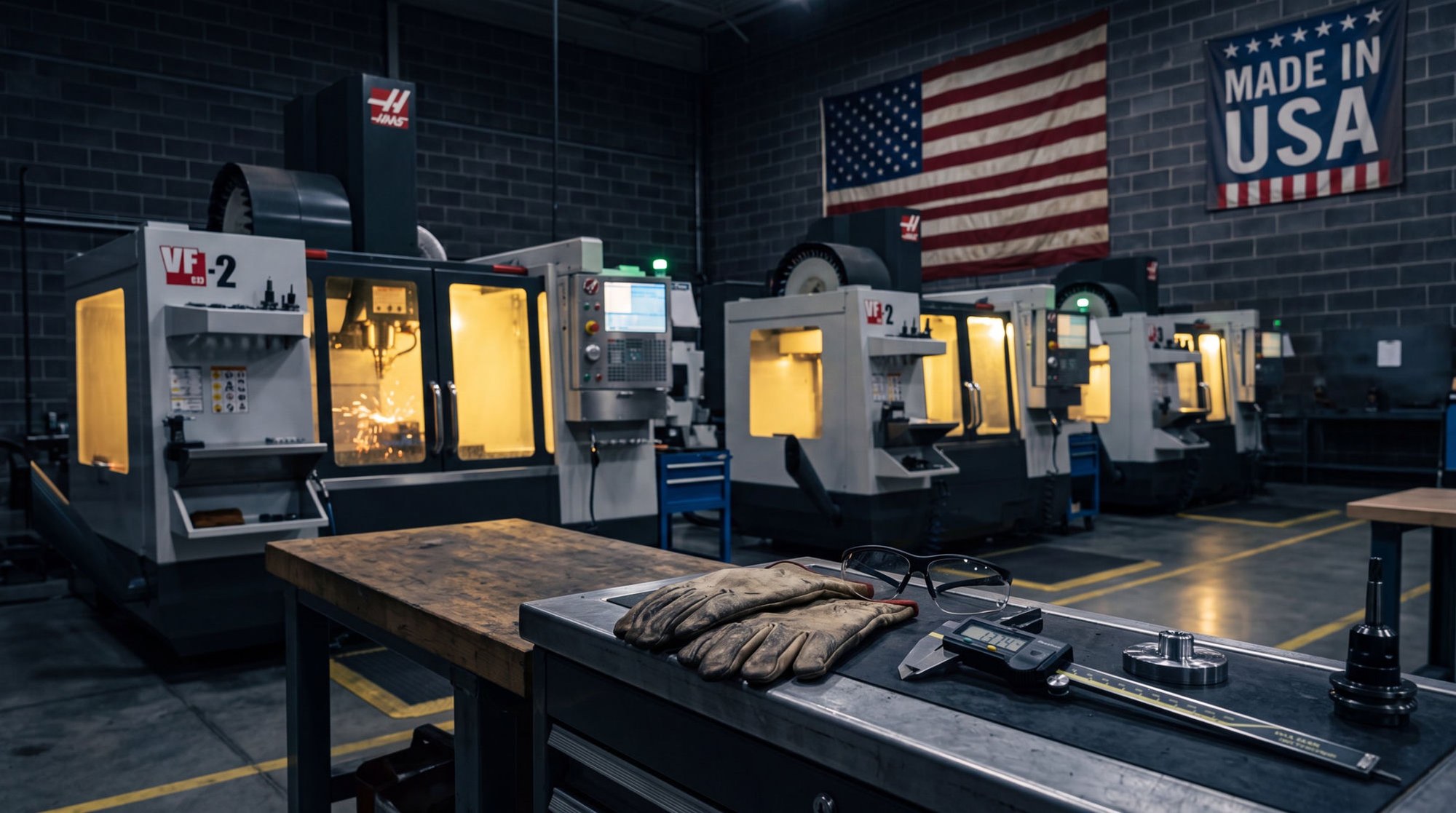
EGM Manufacturing — A full-service CNC precision machine shop in Sunrise, Florida, delivering quality, speed, and reliability since 2005.
American manufacturers are bringing work home at the fastest pace in a generation. Tariff uncertainty, fragile overseas logistics, and the strategic risk of depending on distant suppliers have pushed companies across aerospace, automotive, medical, and industrial markets to source precision components closer to where they are designed and assembled. The problem is that the wave of returning work is arriving exactly as the skilled workforce needed to perform it is thinning out. That collision — surging domestic demand against a shrinking pool of experienced machinists — is now the defining tension in U.S. precision manufacturing, and it is quietly reshaping how parts get quoted, scheduled, and delivered across the entire country.
The workforce side of the equation is not speculation. According to the U.S. Bureau of Labor Statistics, machinists held roughly 299,500 jobs in 2024, with employment projected to dip about 2 percent through 2034 as automation lets fewer people produce more parts. Yet the same data tells a more urgent story underneath the headline: the field is expected to generate around 34,200 openings every year for the next decade, almost entirely because experienced machinists are retiring or moving into adjacent roles faster than newcomers replace them. A declining job count paired with persistent openings is the statistical fingerprint of a labor shortage, not a surplus — and for the companies that depend on machined parts, it means the competition for reliable capacity is only going to intensify.
Reshoring Is Pulling Work Back to American Shops
For two decades, the default answer to cost pressure was to offshore machining to lower-wage regions. That logic has eroded. Pandemic-era disruptions exposed how a single delayed container or a closed foreign plant could halt an entire production line, and many firms concluded that the cheapest unit price means little if the part never arrives. Currency swings, rising overseas labor costs, intellectual-property concerns, and the sheer unpredictability of long-distance freight have all chipped away at the offshore math that once looked unbeatable on a spreadsheet.
Engineering teams also rediscovered the hidden value of proximity. When a machinist sits a short drive — not an ocean and a twelve-hour time difference — away, design revisions, tolerance questions, and first-article problems get resolved in days instead of weeks. A prototype can be picked up, evaluated, and revised inside a single sprint rather than a single quarter. That responsiveness shortens product development cycles and reduces the cost of mistakes, because errors are caught and corrected before they multiply across a production run.
The result is a steady migration of precision work back to domestic shops, with the strongest pull in industries where tolerances are tight and traceability is non-negotiable. The same forces are rewiring entire industry supply chains, a shift explored in depth in Aerospace and Defense Demand Is Rewiring the Precision Parts Supply Chain. For machine shops, reshoring is an opportunity and a stress test at once: the orders are coming, but only shops that can actually staff and schedule the work will capture them. The firms that hesitated to invest in equipment and people during the leaner years are now discovering that demand alone does not solve a capacity problem.
The Workforce Math Doesn’t Add Up
The shortage is not evenly distributed across the trade. BLS data shows that CNC tool programmers — the people who translate CAD models into the machine instructions that actually cut the metal — number only in the low tens of thousands nationwide, making experienced programmers some of the most fiercely contested talent in the sector. Operators, machinists, and programmers each sit on a different rung of the same ladder, and every rung is harder to fill than it was a decade ago because the generation that learned the craft on manual machines is aging out faster than apprentices can be trained to replace it.
Part of the challenge is perception. For years, manufacturing careers were portrayed to young people as dirty, repetitive, and on their way out — a narrative that steered talent toward other fields even as modern shops became clean, climate-controlled, and increasingly digital. The reality is that today’s machinist works with sophisticated CAD/CAM software, multi-axis equipment, and computerized inspection systems, often earning a solid middle-class wage without the debt load of a four-year degree. But reversing a decade of misperception takes time the industry does not have.
The macroeconomic stakes are enormous. A widely cited study by Deloitte and The Manufacturing Institute warned that the manufacturing skills gap could leave as many as 2.1 million jobs unfilled by 2030, at a potential cost of up to $1 trillion to the U.S. economy. Precision machining roles, which demand both hands-on craft and digital fluency, rank among the toughest of all to fill. The consequences land directly on the companies buying parts: longer lead times, more shops declining work they cannot staff, and quality risk at operations that stretch a thinning crew across too many jobs at once. When a shop is short-handed, the first casualties are usually schedule reliability and the careful documentation that complex industries require.
Automation Is Closing the Gap — But Only Partly
The industry’s most visible response has been to make every skilled worker dramatically more productive. Robot-tended cells, automated pallet changers, bar feeders, and in-process probing now let a single technician oversee several machines at once, pushing toward “lights-out” runs that keep spindles cutting through the night with minimal supervision. Multi-axis machining centers compound the effect by completing complex parts in fewer setups, which removes the repositioning steps where errors, delays, and scrap accumulate. A shop that once needed three operators and three machines to finish a part may now finish it on one machine with one operator overseeing the cell.
But automation amplifies skilled labor; it does not replace the judgment behind it. Someone still has to program the toolpaths, prove out the first article, interpret a metrology report, select the right cutting tools and feeds for an exotic alloy, and decide what to do when a tool wears faster than expected or a casting arrives slightly out of spec. The machines are only as good as the people directing them. This is why the shortage cannot simply be automated away: the more advanced the equipment becomes, the more it depends on the experienced programmers and machinists who are themselves in short supply.
The shops thriving in this environment are the ones pairing modern equipment with the experienced people who know how to wield it — a combination that is becoming a genuine competitive moat as that experience grows scarcer. Capital can buy a five-axis machine in a matter of months; it cannot buy twenty years of a programmer’s accumulated know-how on the same timeline.
Why Single-Operation Machining Matters Now
In a labor-constrained market, the most valuable capability a shop can offer is doing more with fewer touches. Every time a part moves from one machine to another, it consumes scheduling time, handling labor, fixturing, and an opportunity for error. It also adds queue time — the part waits for the next machine to come free, and that waiting often dwarfs the actual cutting time. Completing a part in a single operation on a multi-axis center collapses that sequence, which is why buyers increasingly prioritize shops that can hold tolerance across milling and turning without shuttling work down the hall or out to a subcontractor.
Single-operation machining is not just an efficiency play; it is a quality play. Each re-clamping of a part reintroduces the risk of misalignment, and on tight-tolerance components that risk is expensive. Finishing a part in one setup means the datum references stay consistent from the first cut to the last, which is precisely what aerospace, medical, and defense customers need. Speed has become a deciding factor in its own right — a dynamic examined further in Why Lead Time Has Become the Deciding Factor in Precision Machining — and single-operation capability is one of the most direct ways a shop delivers it.
What Buyers Should Look For in a Domestic Partner
Reshoring only pays off if the domestic partner can actually deliver. As supply chains shorten, buyers are scrutinizing certifications, equipment depth, and realistic lead-time commitments far more carefully than price alone. Quality systems such as ISO 9001 and AS9100 signal that a shop documents and controls its processes — the difference between a vendor that occasionally produces a good part and one that does so repeatably, with full traceability, batch after batch. In regulated industries, those certifications are often a hard prerequisite rather than a nice-to-have.
Equipment range matters just as much. A shop with 3-, 4-, and 5-axis capability, plus turning and in-house metrology, can absorb a wider variety of jobs without subcontracting steps that introduce delay and finger-pointing when something goes wrong. In-house inspection is especially important: when measurement happens under the same roof as machining, problems are caught immediately instead of after a part has shipped. Workforce stability rounds out the picture. The shops best positioned for the reshoring decade are those that have retained experienced machinists and built the equipment base to multiply their output. For manufacturers weighing where to place returning work, those are the questions worth asking first — long before the conversation turns to unit cost.
EGM Manufacturing: Precision Machining Built for the Reshoring Era
EGM Manufacturing is a full-service CNC precision machine shop in Sunrise, Florida, serving the aerospace, automotive, construction-commercial, and medical markets since 2005. With 3-, 4-, and 5-axis machining centers, CNC turning centers, and precision metrology equipment, EGM completes most parts in a single operation — and backs every job with ISO 9001:2015 and AS9100 certification. As one of South Florida’s most capable machine shops, EGM helps customers turn ideas and requirements into manufacturing solutions delivered on time and to specification.
Our Services Include:
- Multi-Axis CNC Milling — Complex geometries completed in fewer setups on 3-, 4-, and 5-axis centers
- CNC Turning — Precision turned components held to tight tolerances
Ready to bring your work home? Contact EGM Manufacturing to discuss how our equipment and experience can keep your precision parts on schedule and on specification.
Works Cited
- “Machinists and Tool and Die Makers.” Occupational Outlook Handbook, U.S. Bureau of Labor Statistics, U.S. Department of Labor, www.bls.gov/ooh/production/machinists-and-tool-and-die-makers.htm. Accessed 22 June 2026.
- “2.1 Million Manufacturing Jobs Could Go Unfilled by 2030.” The Manufacturing Institute, themanufacturinginstitute.org/2-1-million-manufacturing-jobs-could-go-unfilled-by-2030-11330/. Accessed 22 June 2026.