
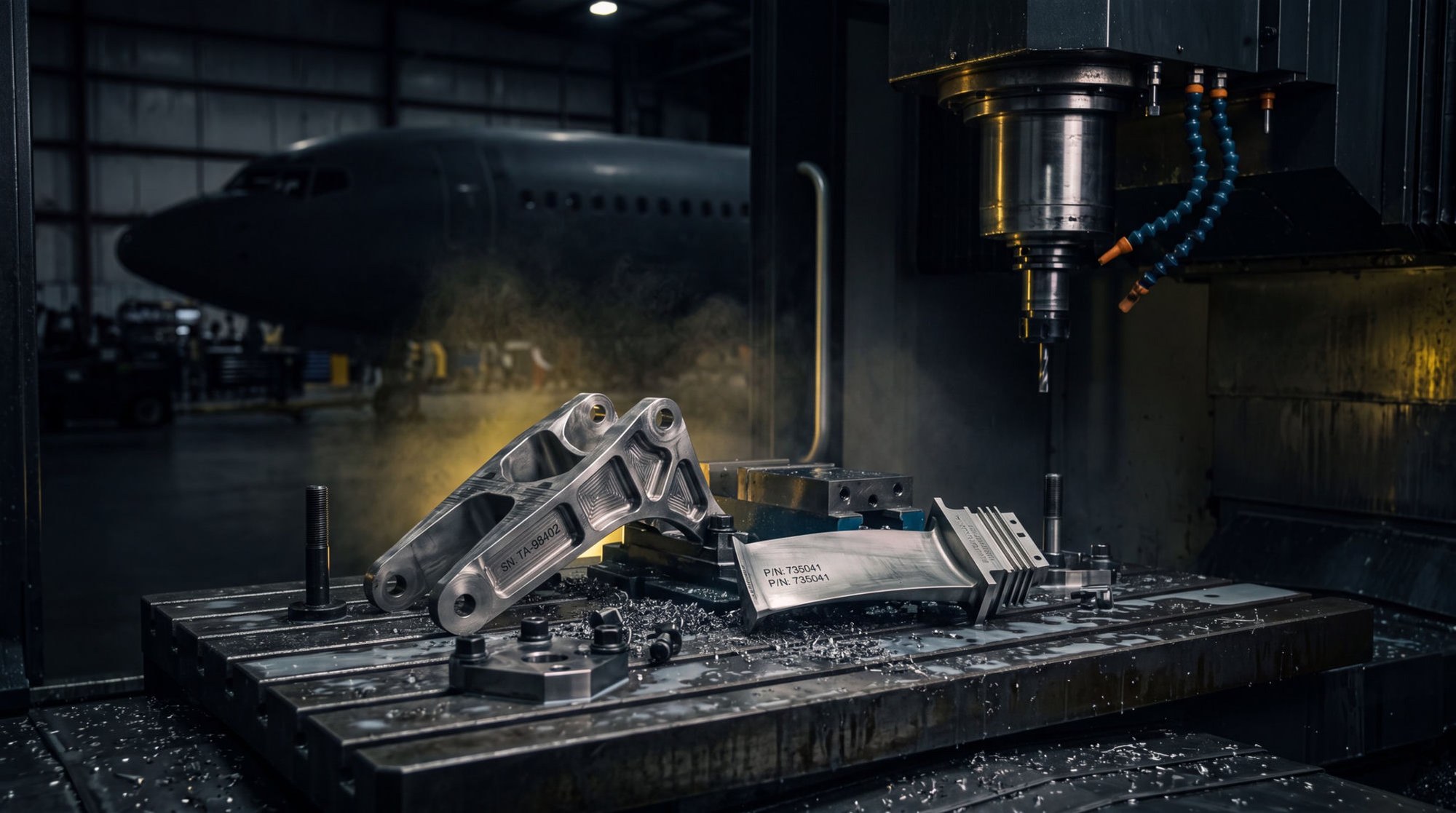
EGM Manufacturing — A full-service CNC precision machine shop in Sunrise, Florida, delivering quality, speed, and reliability since 2005.
Aerospace and defense are entering a sustained build cycle, and the precision parts supply chain that feeds it is being reorganized around speed, traceability, and proximity. Air travel demand keeps climbing, airlines are replacing older airframes with more fuel-efficient models, and defense programs continue to draw on a deep base of suppliers capable of holding aerospace-grade tolerances. Behind every one of those aircraft sits a long chain of machined brackets, housings, fittings, and structural components — and the shops that produce them are under more pressure, and more scrutiny, than they have faced in years.
The demand signal is concrete. The Federal Aviation Administration projects that the U.S. commercial aircraft fleet will grow from about 7,387 aircraft in 2024 to 10,607 by 2045, an average expansion of roughly 1.7 percent per year, with the mainline passenger jet fleet alone forecast to climb from 4,829 to 6,854 over the same period. Every new airframe — and every older one carriers retire and replace — represents thousands of precision components that must be manufactured, inspected, and documented. That is a multi-decade tailwind for the machining supply chain, not a passing spike, and it arrives at a moment when capacity is already stretched thin.
A Build Cycle That Rewards Certified Suppliers
Aerospace work is unforgiving in ways that separate qualified shops from general machinists. Parts are often cut from difficult materials — titanium, Inconel, hardened stainless, aerospace aluminum — that punish worn tooling and imprecise toolpaths. Tolerances run into the microns, and every dimension must be traceable back through inspection records, material certifications, and process documentation. A single undocumented deviation can disqualify an entire lot. That is why the AS9100 quality standard, layered on top of ISO 9001, functions as a gatekeeper: without it, a shop simply cannot win most aerospace and defense contracts, regardless of how capable its machines are on the floor.
The U.S. aerospace and defense sector remains one of the country’s strongest manufacturing exporters, supported by a dense network of specialized suppliers. The International Trade Administration works to expand the global competitiveness of that industry, reflecting how strategically important these supply chains have become to both the economy and national security. As prime contractors push for more domestic content and tighter oversight, the certified shops in that network are absorbing work that once flowed overseas — the broader reshoring shift detailed in The Reshoring Boom Is Colliding With a Machinist Shortage.
Certification is not a one-time hurdle, either. AS9100 demands continuous auditing, corrective-action discipline, and a documented quality management system that touches every stage from quoting to final inspection. For buyers, that rigor is precisely the point: it is the difference between a supplier who occasionally produces a conforming part and one who can prove conformance, part after part, across a multi-year program. In a sector where a failed component can ground a fleet or compromise a mission, that proof is worth more than a marginally lower piece price.
Why Multi-Axis Milling Has Become Table Stakes
The geometric complexity of modern aerospace parts is pushing shops toward 5-axis machining as a baseline rather than a premium. Structural components increasingly feature compound angles, internal pockets, and contoured surfaces that would require numerous setups on a 3-axis machine — each setup adding handling time, fixturing cost, and a fresh chance to introduce misalignment. Multi-axis centers cut those features in a single setup, which improves accuracy precisely because the part never has to be re-clamped and re-indicated between operations.
That single-setup advantage does more than improve quality. It compresses lead time, reduces work-in-process inventory, and lets a shop quote complex parts that less-equipped competitors have to pass on or subcontract. Subcontracting a finishing operation introduces another vendor, another shipping leg, and another opportunity for schedule slippage and finger-pointing when something goes wrong. In a build cycle where prime contractors need parts faster than ever, the ability to take a complex aerospace component from raw stock to finished, inspected part under one roof is a direct competitive edge — and increasingly an expectation rather than a differentiator.
The Materials Challenge Behind the Demand
The materials that make modern aircraft lighter and more efficient are also the hardest to machine. Titanium and nickel-based superalloys like Inconel deliver the strength-to-weight and heat resistance that engines and structures require, but they generate extreme cutting temperatures, wear tooling rapidly, and demand carefully controlled feeds, speeds, and coolant strategies. A shop that has not invested in the right machines, tooling, and programming expertise can burn through cutting tools and scrap expensive raw stock faster than it can deliver finished parts.
This is where experience compounds capital. Two shops can own identical five-axis machines and still produce very different results, because the difference lies in the programmer who knows how to approach a thin-walled titanium bracket without inducing distortion, and the machinist who recognizes the early signs of tool wear before it ruins a surface finish. As that experienced talent becomes scarcer across the industry, the shops that have retained it are pulling ahead — they can quote aggressive timelines on hard materials with confidence, while others hedge or decline the work entirely.
The Backlog Problem — and the Premium on Speed
Demand has outrun capacity across much of the durable-goods economy, and aerospace sits squarely in the middle of it. Transportation equipment, which includes aircraft and parts, has repeatedly led monthly increases in new orders. The pileup of unfilled work is the clearest symptom: U.S. manufacturers’ backlogs have been growing for most of the past two years, a trend that turns a supplier’s responsiveness into a strategic asset. Buyers facing their own delivery commitments cannot afford a machining partner who quotes twelve weeks when a competing program needs the part in three.
This is where capacity, automation, and certification converge. A shop that can hold AS9100 documentation while running modern multi-axis equipment — and actually staff it with experienced people — becomes the kind of supplier primes want to lock in for the long haul rather than re-source every year. The speed dimension of that equation is explored further in Why Lead Time Has Become the Deciding Factor in Precision Machining. As backlogs deepen, the supplier who can deliver a correct part first is increasingly the supplier who wins the next contract.
What It Means for the Supply Chain Going Forward
The aerospace parts supply chain is consolidating around fewer, more capable suppliers. Prime contractors are reducing the number of vendors they manage while demanding more from each — broader capability, faster turns, airtight documentation, and the financial and workforce stability to deliver across a multi-year program. Smaller, undercapitalized shops without certification or multi-axis depth are increasingly squeezed out, while certified shops that invested in equipment and quality systems are pulling in a larger share of the work.
For component buyers, the practical takeaway is to qualify partners on the full picture: certification, material expertise, machine range, inspection capability, and a demonstrated track record of on-time delivery. In a tightening market, those attributes — not headline price — determine whether parts arrive on schedule and to specification. The cost of a missed delivery in aerospace, measured in stalled assembly lines and penalty clauses, dwarfs whatever savings a marginally cheaper but less reliable vendor might promise.
Geography is becoming part of that calculation as well. Defense programs increasingly carry domestic-content requirements, and commercial primes burned by overseas disruptions are deliberately shortening their supplier maps. A capable shop located within the United States — close enough for an engineer to visit, audit, and collaborate with in person — now offers a kind of supply-chain insurance that a distant low-cost vendor cannot match. For many buyers, that proximity has moved from a nice-to-have to a deciding factor when awarding long-term work.
EGM Manufacturing: Aerospace-Ready Precision Machining
EGM Manufacturing is a full-service CNC precision machine shop in Sunrise, Florida, serving the aerospace, automotive, construction-commercial, and medical markets since 2005. Holding both AS9100 and ISO 9001:2015 certifications, EGM uses 3-, 4-, and 5-axis machining centers and precision metrology equipment to complete most parts in a single operation — with lead times as short as 1 to 3 days, even on complex geometries. EGM’s strength lies in helping customers turn demanding requirements into precision components delivered on time and to specification.
Our Services Include:
- Multi-Axis CNC Milling — 3-, 4-, and 5-axis machining for complex aerospace components in fewer setups
- Short-Run Production — Competitive pricing on precision components regardless of project volume
Need a certified machining partner? Contact EGM Manufacturing to discuss your aerospace and defense component requirements.
Works Cited
- “FAA Aerospace Forecasts Fiscal Years 2025–2045.” Federal Aviation Administration, U.S. Department of Transportation, www.faa.gov/data_research/aviation/aerospace_forecasts. Accessed 22 June 2026.
- “SelectUSA Aerospace Industry.” International Trade Administration, U.S. Department of Commerce, www.trade.gov/selectusa-aerospace-industry. Accessed 22 June 2026.