
EGM Manufacturing — A full-service CNC precision machine shop in Sunrise, Florida, delivering quality, speed, and reliability since 2005.
For most of the last two decades, the first question a buyer asked a machine shop was about price. Today, the first question is increasingly about time. How fast can you quote it? How soon can you ship the first article? Can you absorb a design change without resetting the clock? In a manufacturing economy running with stretched backlogs and volatile supply chains, speed-to-first-part has overtaken unit cost as the factor that decides who wins the work — and that shift is rewarding shops built for prototyping and short-run agility rather than high-volume sameness.
The backlog data makes the urgency plain. The U.S. Census Bureau reported that new orders for manufactured durable goods rose 7.9 percent to $346.0 billion in a single recent month, while unfilled orders climbed for the twenty-first time in twenty-two months to roughly $1,569.0 billion. A backlog that deep means demand is outpacing the system’s ability to produce, and every week a part sits in a queue is a week a customer’s own delivery slips. In that environment, a supplier’s responsiveness is no longer a nicety — it is the product itself, as central to the value proposition as the tolerances the shop can hold.
Volatility Has Made Speed a Survival Trait
Supply chains have not returned to the predictable rhythm of the pre-pandemic era. Demand swings, material availability, tariff shifts, and engineering revisions all arrive with less warning, and manufacturers have responded by ordering in smaller, more frequent batches rather than committing to long production runs they may have to rework. That behavior changes what they need from a machining partner: not the lowest price on 100,000 identical parts, but the ability to turn a few dozen precise parts — or a single prototype — quickly and correctly, then iterate as the design or the forecast moves.
This is precisely the work that struggles in offshore, high-volume supply chains, and it is a major reason precision machining keeps migrating back to domestic shops. The broader pull of that reshoring trend is examined in The Reshoring Boom Is Colliding With a Machinist Shortage. When a part has to be right and fast, proximity and flexibility beat distance and scale — a shipping container saved nothing if the part inside is three weeks late or a revision behind.
The cost of waiting has also become easier to quantify. When a stalled component holds up an assembly line, idles a crew, or pushes a product launch past a market window, the dollar value of that delay quickly eclipses any per-part savings won by sourcing far away. Procurement teams that once optimized almost entirely for unit price are now building lead time and reliability into their sourcing decisions as first-order criteria, not footnotes.
Prototyping Is Where Lead Time Is Won or Lost
New product development lives and dies on iteration speed. An engineer who can get a machined prototype in days instead of weeks can test, refine, and finalize a design while competitors are still waiting on a first sample. That compression has real commercial value: faster prototyping shortens the entire path to production, reduces the cost of design mistakes by catching them early, and gets finished products to market sooner — often the difference between leading a category and chasing it.
The shops that excel at prototyping share a recognizable profile. They quote quickly, program efficiently, and run multi-axis equipment that can produce a complex one-off without elaborate, time-consuming tooling. They communicate openly about what is manufacturable and what is not, flagging a tolerance or a wall thickness that will cause problems before any metal is cut. That early, candid feedback loop saves the customer from expensive redesigns downstream and is itself a form of speed, because it removes iterations that would otherwise have to happen the slow way.
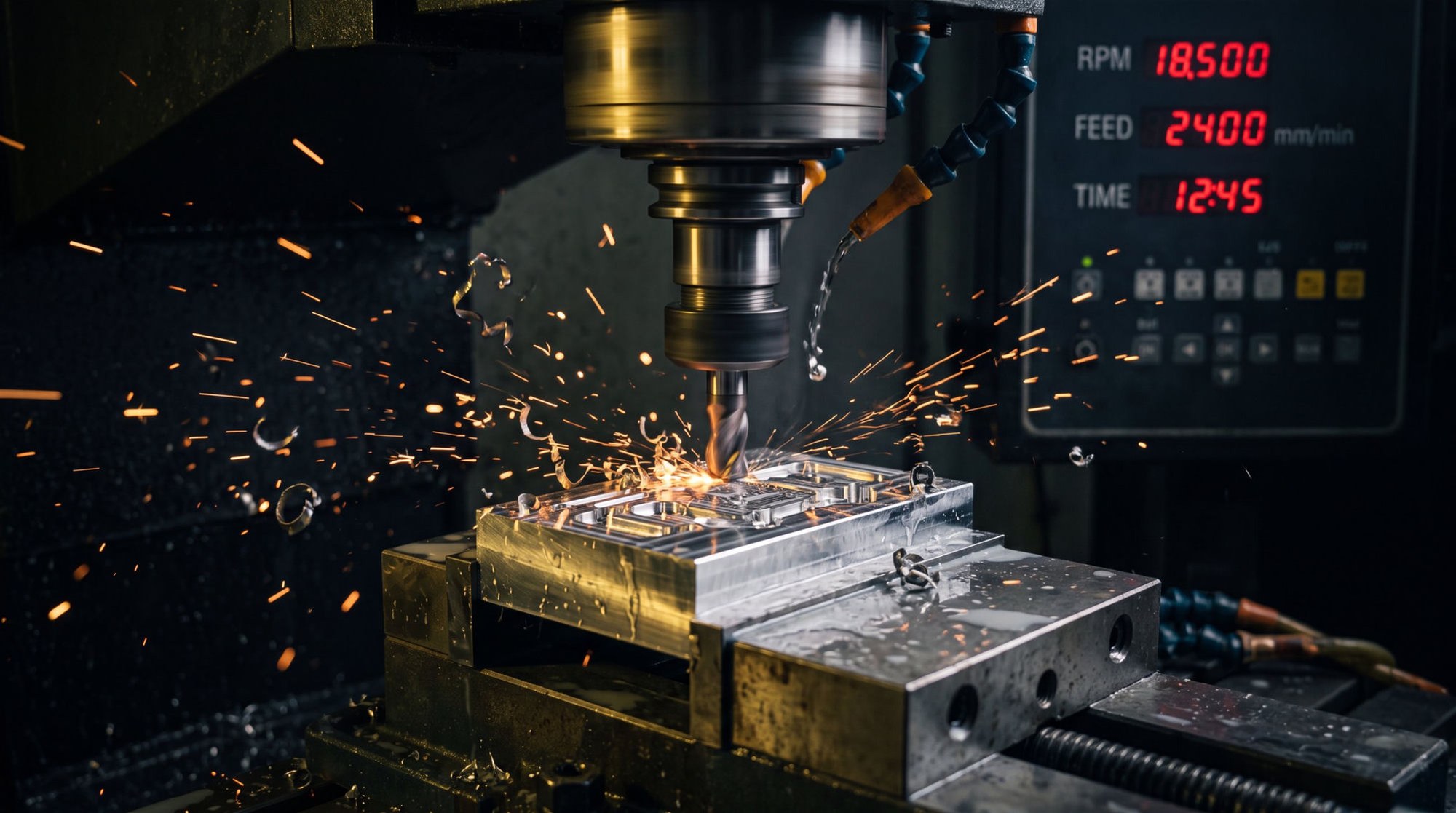
Equipment depth is what makes that speed repeatable rather than occasional. A shop with in-house milling, turning, and metrology can take a prototype from raw stock to a fully inspected, documented part without waiting on outside vendors for a single operation. Each external handoff a job avoids is time it does not spend in transit or in someone else’s queue. When all of those capabilities live under one roof, the quote-to-delivery clock shrinks dramatically — and the customer gets a partner who owns the timeline end to end instead of one who points to a subcontractor when a deadline slips.
From Prototype to Short Run Without Re-Sourcing
One of the most underrated lead-time advantages is continuity. When a single shop can carry a part from prototype through the first small production batch, nothing has to be relearned along the way — the design intent, the fixturing approach, the programming, and the inspection setup all carry straight through. The customer avoids the delay and risk of qualifying a second vendor, re-proving the process, and hoping the new shop interprets the drawing the same way the first one did.
That continuity matters most in exactly the markets where short runs are common: medical devices, aerospace, specialized automotive, and industrial equipment, where volumes are modest but precision and documentation are non-negotiable. A shop that treats a 25-piece run with the same rigor it brings to a prototype — and can scale that run up smoothly if demand grows — becomes a partner rather than a transactional vendor. Re-sourcing between every stage, by contrast, injects delay precisely when a product is trying to gain momentum.
The Role of Domestic Small and Mid-Sized Shops
Small and mid-sized manufacturers are the backbone of this responsive, short-run capacity, and their importance to national supply-chain resilience is widely recognized. The Manufacturing Extension Partnership, administered through the U.S. Department of Commerce’s National Institute of Standards and Technology, works specifically to strengthen small and medium-sized U.S. manufacturers through a nationwide network of centers. These are the firms that absorb the rush jobs, the prototypes, and the low-volume specialty work that keeps larger production programs moving — the flexible layer that a brittle, offshore-only supply chain cannot replicate.
Their value rises as backlogs grow. When a large supplier is booked solid, a nimble domestic shop that can slot in a short run on short notice becomes the release valve that keeps a customer’s line running. Speed and flexibility, not sheer scale, are their competitive currency — and in a backlogged economy, that currency is appreciating. The shops that pair this agility with modern equipment and solid quality systems are increasingly the ones large manufacturers turn to first when a schedule is on the line.
How to Spot a Lead-Time-Ready Partner
Buyers evaluating machining partners on speed should look past advertised turnaround claims and probe the underlying capability. Does the shop complete parts in a single operation, or shuttle them between machines and add days at each handoff? Does it have in-house metrology so inspection does not become its own bottleneck? Can it carry a job seamlessly from prototype to short-run production? And does it hold the quality certifications that let it move fast without cutting corners on documentation? Those questions reveal far more about real-world lead time than a headline quote ever will.
The same dynamics raising the premium on speed are reshaping high-stakes sectors like aerospace, where complex parts and tight tolerances make responsiveness even more valuable — a connection explored in Aerospace and Defense Demand Is Rewiring the Precision Parts Supply Chain. Across every market, the conclusion is the same: in a backlogged economy, the partner who can deliver a correct part first is the partner who wins the next order, and the one after that.
EGM Manufacturing: Built for Speed Without Sacrificing Precision
EGM Manufacturing is a quick-turnaround, full-service CNC precision machine shop in Sunrise, Florida, serving the aerospace, automotive, construction-commercial, and medical markets since 2005. With 3-, 4-, and 5-axis machining centers and precision metrology equipment, EGM completes most parts in a single operation and delivers premium components in as little as 1 to 3 days — even on complex geometries — all backed by ISO 9001:2015 and AS9100 certification. From fast-turnaround prototypes to repeatable short runs, EGM is built to keep your timelines intact.
Our Services Include:
- CNC Prototyping — Fast-turnaround prototypes that compress your path to production
- Short-Run Production — Competitive pricing on precision short runs, no matter the project volume
Need it fast and right? Contact EGM Manufacturing to discuss your prototyping and short-run production timelines.
Works Cited
- “Monthly Advance Report on Durable Goods Manufacturers’ Shipments, Inventories, and Orders.” U.S. Census Bureau, U.S. Department of Commerce, www.census.gov/manufacturing/m3/adv/current/index.html. Accessed 22 June 2026.
- “Manufacturing Extension Partnership (MEP).” National Institute of Standards and Technology, U.S. Department of Commerce, www.nist.gov/mep. Accessed 22 June 2026.