
EGM Manufacturing — A full-service CNC precision machine shop in Sunrise, Florida, delivering quality, speed, and reliability since 2005.
Turned parts are everywhere, even if most people never notice them. The shaft inside an electric motor, the fitting on a hydraulic line, the bushing in a landing-gear assembly, the threaded connector on a medical instrument — all of them start as a bar of metal spinning in a lathe while a cutting tool shapes it to within a fraction of a hair. As U.S. factories run hard to meet broad-based demand, precision CNC turning has quietly become one of the busiest corners of the machining world, and the shops that do it well are fielding more work than they can easily absorb.
The macro backdrop helps explain why. According to the Federal Reserve, total industrial production recently sat about 1.7 percent above its year-earlier level, with manufacturing capacity utilization hovering around 75.7 percent. Factories are producing more than they were a year ago and running a meaningful share of their available capacity, which means the components that feed them — including the turned shafts, pins, and fittings that hold machines and vehicles together — are in steady, rising demand. When the broader industrial base is busy, turning shops feel it first, because rotational parts are foundational to almost everything that gets assembled.
The Demand Drivers Behind Turned Components
Several industries are pulling on turning capacity at once. Automotive is among the largest. Internal-combustion and electric vehicles alike rely on turned components — shafts, sleeves, valve bodies, fasteners, and connector housings — and the shift toward electrification is adding new categories of precision rotational parts for motors, power electronics, and thermal-management systems.
That electrification trend is real and measurable. U.S. Department of Energy data shows that electric vehicles have been the fastest-growing light-duty vehicle category by registration in recent years, with Florida among the states carrying one of the largest EV populations in the country. Every one of those vehicles represents a fresh bill of materials full of machined parts, and many of the highest-precision items on that list are turned. As the vehicle mix evolves, suppliers that can turn tight-tolerance components from a range of materials are positioned to capture work that did not exist a decade ago.
Automotive is far from the only driver. Industrial machinery, hydraulics and pneumatics, oil-and-gas equipment, defense systems, and medical devices all consume turned parts in volume. Medical work in particular demands extreme precision and biocompatible materials for items like bone screws, surgical-instrument components, and implant features — exactly the kind of small, exacting rotational parts that modern turning centers excel at producing. Across all of these markets, the common thread is the same: tolerances are tightening, lead-time expectations are shrinking, and buyers want a supplier who can deliver consistent quality at the volumes they actually need.
What Makes Turning Different — and Demanding
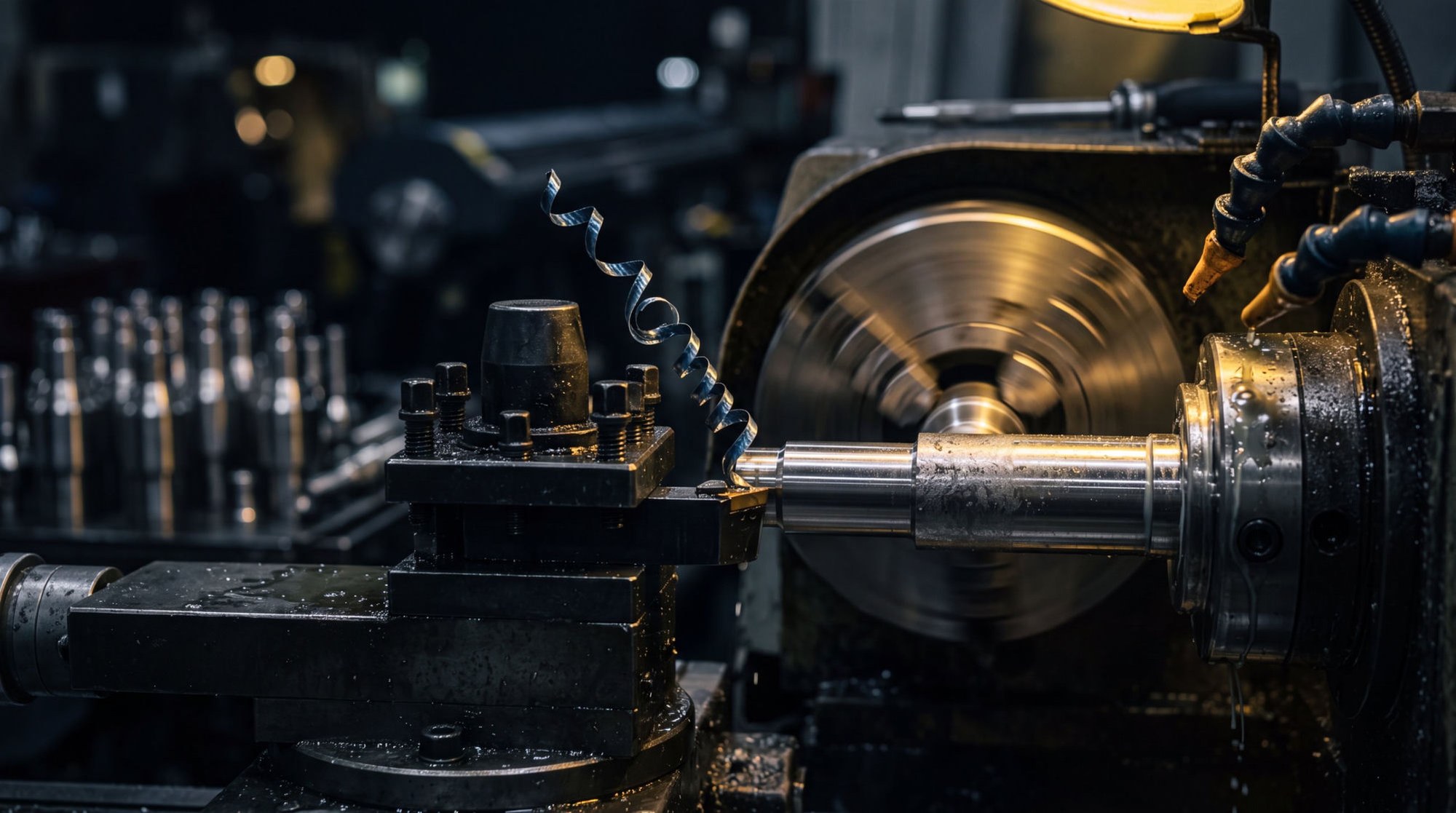
Turning is conceptually simple — the workpiece rotates while a stationary tool removes material — but doing it to precision standards is anything but. Holding a diameter to a few microns across an entire production run requires tight control of tooling, spindle behavior, thermal conditions, and material consistency. Long, slender parts can deflect under cutting forces; hard alloys can chatter or work-harden; and surface finish requirements on sealing surfaces or bearing journals leave no room for guesswork. A turned part that looks right to the eye can still fail an inspection by a measurement no wider than a wavelength of light.
This is why experience and equipment matter so much in turning. Modern CNC turning centers, including multi-axis and Swiss-style machines, can perform turning, milling, drilling, and threading in a single setup, producing complex finished parts without moving the workpiece to a second machine. That capability is a quality advantage as much as a speed advantage: every operation completed in one setup is one less chance to introduce a misalignment between features that have to line up perfectly.
Material range adds another layer of difficulty. A turning shop serving multiple industries may move from free-machining brass and aluminum to stainless steel, titanium, and high-temperature alloys within the same week, and each material behaves differently under the tool. Speeds, feeds, coolant strategy, and tool selection all have to change accordingly, and the operator who gets it wrong pays in scrapped stock, premature tool wear, or a surface finish that fails inspection. The shops that thrive are the ones whose programmers and machinists have logged enough hours across enough materials to dial in the right approach quickly — a depth of know-how that cannot be bought off the shelf and is becoming harder to replace as veterans retire.
Automation Is Helping Shops Keep Pace
With skilled machinists in short supply and order books full, turning shops are leaning hard on automation to keep spindles cutting. Integrated bar feeders let a lathe run unattended for hours, pulling fresh stock and machining part after part without an operator loading each blank by hand. Multitasking lathes consolidate operations that once required several machines. Robotic part handling, automatic tool monitoring, and in-process gauging keep production moving across shifts and catch problems before they turn into scrap.
The payoff is that a single skilled technician can oversee several machines at once, turning a scarce-labor problem into a throughput advantage. That responsiveness is increasingly what buyers reward — a theme explored in Why Lead Time Has Become the Deciding Factor in Precision Machining. In a market where the supplier who delivers first often wins the next order, automation in turning is less about cutting headcount than about protecting delivery dates when demand spikes.
The Single-Source Advantage: Turning and Milling Under One Roof
Many precision parts are not purely turned or purely milled — they combine rotational features with flats, slots, holes, and contoured surfaces. When a shop can both turn and mill in-house, those parts never have to leave the building to be finished. The customer deals with one vendor, one quality system, and one schedule, instead of coordinating handoffs between a turning shop and a milling shop and absorbing the delay and risk at every transfer.
That single-source capability is becoming a baseline expectation rather than a premium. It shortens lead times, simplifies accountability, and keeps tolerances consistent because the same shop controls the part from raw stock to final inspection. For buyers juggling tight timelines and complex geometries, a partner who can do both turning and milling — and verify the results with in-house metrology — removes a whole layer of supply-chain friction.
Why Domestic Turning Capacity Matters Now
The same forces reshaping the broader machining sector are reshaping turning. As companies bring work back onshore to shorten supply chains and reduce risk, demand for domestic turning capacity is climbing even as the experienced workforce tightens — the dynamic examined in The Reshoring Boom Is Colliding With a Machinist Shortage. For buyers, that means securing reliable turning capacity is no longer something to take for granted; the best shops are booking out, and relationships with capable, certified suppliers are worth protecting.
The practical response is to qualify turning partners on the full picture: the range of materials they can run, their tolerance and finish capability, their automation and inspection depth, and their track record on delivery. A shop that pairs modern turning centers with experienced people and solid quality systems can hold tight tolerances at the volumes a project actually requires — and keep doing it as demand grows rather than buckling under it.
EGM Manufacturing: Precision Turning Backed by Full Machining Capability
EGM Manufacturing is a full-service CNC precision machine shop in Sunrise, Florida, serving the aerospace, automotive, construction-commercial, and medical markets since 2005. With CNC turning centers, 3-, 4-, and 5-axis machining centers, and precision metrology equipment, EGM completes most parts in a single operation — turning and milling complex components under one roof and backing every job with ISO 9001:2015 and AS9100 certification. Lead times run as short as 1 to 3 days, even on demanding geometries.
Our Services Include:
- CNC Turning — Precision turned components held to tight tolerances across a range of materials
- Multi-Axis CNC Milling — 3-, 4-, and 5-axis machining that completes complex features in fewer setups
Need precision turned parts on a tight timeline? Contact EGM Manufacturing to discuss your turning and machining requirements.
Works Cited
- “Industrial Production and Capacity Utilization — G.17.” Board of Governors of the Federal Reserve System, www.federalreserve.gov/releases/g17/current/default.htm. Accessed 22 June 2026.
- “Vehicle Registration Counts by State.” Alternative Fuels Data Center, U.S. Department of Energy, afdc.energy.gov/vehicle-registration. Accessed 22 June 2026.