
The machining is done, the part measures good, and one question remains: what happens to the surface? CNC machining finishing options range from leaving the part as machined to anodizing, plating, passivating, or coating it. The right choice depends on what the part has to survive, how it has to look, and how tight its tolerances are after the finish goes on.
Why Finishing Choices Are Getting a Closer Look in 2026
Some finishes carry more regulatory weight than others. The Environmental Protection Agency is conducting a rulemaking on PFAS discharges from what it calls chrome finishing facilities. EPA found that some facilities use PFAS to control hexavalent chromium emissions, and it identified chromium plating, chromium anodizing, chromic acid etching, and chromate conversion coating as the predominant sources of those discharges.
Worker safety rules already apply. The Occupational Safety and Health Administration notes that hexavalent chromium is known to cause cancer and that chromic acid is used to electroplate chromium onto metal parts. Engineers specifying chrome-based finishes may find finishers asking more questions about process and alternatives.
Common CNC Machining Finishing Options
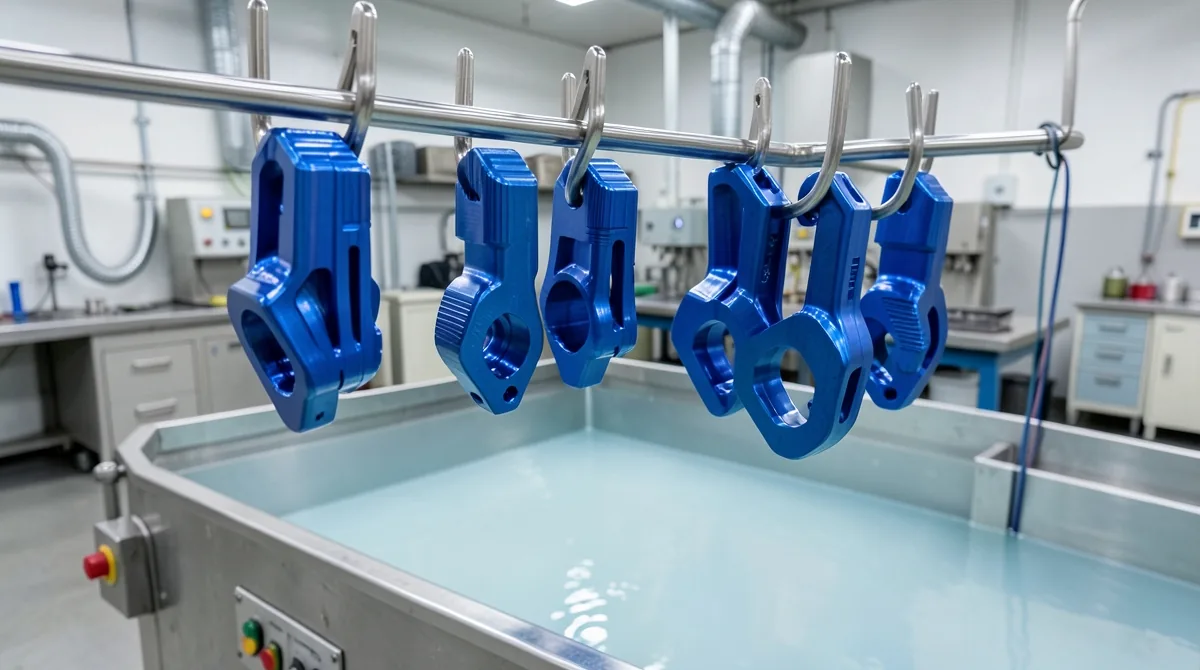
As machined. The part ships with tool marks and no added coating. It suits internal components, fit checks, and parts that will be finished later.
Bead blasting. Fine media gives a uniform matte texture and hides light tool marks.
Anodizing. An electrochemical process builds an oxide layer on aluminum for corrosion and wear resistance, with or without color. Hard anodizing builds a thicker, harder layer, and both types change dimensions slightly.
Passivation. A chemical treatment for stainless steel that removes free iron from the surface and improves corrosion resistance. It is common on medical and food-contact parts.
Plating. A metal layer such as nickel or zinc is deposited on the part for corrosion resistance, wear, solderability, or conductivity. Thickness varies with the specification and the part geometry.
Powder coating and painting. These add a thicker protective or cosmetic layer. Threads, bores, and mating surfaces usually need masking.
Heat treating. Hardening or stress relieving changes material properties rather than the surface alone. Timing matters, because heat treatment can move dimensions.
Polishing, brushing, and engraving. These cover appearance and part marking.
How to Choose a Finish
- Does the part need corrosion protection, and in what environment?
- Does it slide, wear, or carry load at a surface?
- Does it need to conduct electricity or be insulated?
- Are there cleanliness requirements, such as medical or food contact?
- Which dimensions are tight enough that coating thickness matters?
Put the Finish on the Drawing
A vague callout like “anodize black” leaves too much open. A complete callout names the specification, type or class, color, and any masking. The drawing should also state whether dimensions apply before or after finish. Without that note, the machinist and the finisher can each do their job correctly and still produce a part that does not fit.
Finishing Small Batches and Prototypes
Outside finishers often carry minimum lot charges, which weigh heavily on the smallest orders. That matters for buyers using no minimum order CNC machining, where a single coated part can cost more to finish than to machine. Finishing also belongs in the production plan: a finish chosen at the prototype stage should carry into prototype to production CNC machining so that first article parts measure the way production parts will.
What EGM Offers
EGM Manufacturing’s short run production service describes in-house post-processing that includes anodizing, powder coating, plating, heat treating, and engraving. EGM’s published finishing list also includes bead blasting, brushing, polishing, passivating, painting, and screen printing, along with parts shipped as machined. The quote is the place to confirm which finishes a job uses.
Frequently Asked Questions About CNC Machining Finishing Options
01What is a common finish for CNC machined aluminum?
Anodizing is a common finish for CNC machined aluminum because it adds corrosion and wear resistance and can be dyed in many colors. Bead blasting before anodizing gives an even matte look. Parts that only need a fit check or will be coated later are often left as machined.
02Does anodizing change part dimensions?
Yes. Anodizing converts part of the aluminum surface into an oxide layer that also grows outward, so dimensions change slightly. Hard anodizing builds a thicker layer and a larger change. Drawings should state whether dimensions apply before or after anodizing and which features need masking, especially tight bores and threads.
03What is passivation and when is it needed?
Passivation is a chemical treatment for stainless steel that removes free iron and other surface contaminants left from machining. It improves corrosion resistance without adding a coating. It is common on medical, food-contact, and marine parts, and it is typically specified by a standard on the drawing.
04Which surfaces need masking during finishing?
Masking protects surfaces that must stay bare or hold a tight dimension, such as threads, bores, bearing seats, electrical contact points, and mating faces. It is common with anodizing, plating, powder coating, and painting. The drawing should show masked areas clearly so the machine shop and the finisher read the same requirement.
05Can finishing be done on small quantities of CNC parts?
Yes, although outside finishers often charge minimum lot fees that raise the cost per part on the smallest orders. Grouping parts with the same finish into one lot helps. EGM Manufacturing in Sunrise, Florida, offers in-house finishing as part of short-run production, with no volume minimums on machining.
EGM Manufacturing: Precision CNC Machining in Sunrise, Florida
EGM Manufacturing has machined precision parts in Sunrise, Florida since 2005. The shop is ISO 9001:2015 certified, AS9100 certified, and ITAR registered, with no volume minimums — one prototype or a thousand pieces.
Our Services Include:
- Short Run Production — 10 to 1,000 units with repeat order tooling and in-house finishing
- CNC Prototyping — First-article inspection, DFM feedback, and reverse engineering from a drawing or a sample
Have a part other shops won’t quote? Send EGM the print with your material, tolerance, and quantity.
Works Cited
- Occupational Safety and Health Administration. “Hexavalent Chromium.” U.S. Department of Labor, www.osha.gov/hexavalent-chromium. Accessed 19 Sept. 2026.
- U.S. Environmental Protection Agency. “Metal Finishing Effluent Guidelines.” EPA, epa.gov/eg/metal-finishing-effluent-guidelines. Accessed 19 Sept. 2026.
- This article is general industry information and is not a substitute for OSHA guidance, the applicable standard, or a qualified engineer’s assessment of your specific application.