
A hardware startup needs five housings for a demo. An engineer needs three brackets to test a design change. A plant manager needs one replacement shaft. Plenty of machine shops will decline all three, because the order is too small to cover the setup. No minimum order CNC machining exists for exactly these buyers, from the first prototype to the first small batch.
New Companies Start With Small Quantities
New businesses keep forming in 2026. The Census Bureau’s Business Formation Statistics, released September 11, 2026, counted 531,728 seasonally adjusted business applications in August. Of those, 7,910 were in manufacturing, up 0.4 percent from July.
New product companies rarely start with orders of a thousand. They start with one prototype, then five, then twenty for a pilot customer. Each of those steps needs a shop willing to quote it.
Why Many Shops Set Minimums
A machined part carries fixed costs before the first chip. Someone has to review the print, write the CAM program, build or set a fixture, prove out the first part, and inspect it. That setup costs about the same whether the order is five pieces or five hundred.
The math explains the minimum. The same setup spread across five parts adds 100 times more cost to each part than it does spread across 500. For a production-focused shop with a full schedule, small orders also take machine time away from long runs. A minimum order quantity or minimum dollar value filters those jobs out.
What No Minimum Order CNC Machining Changes
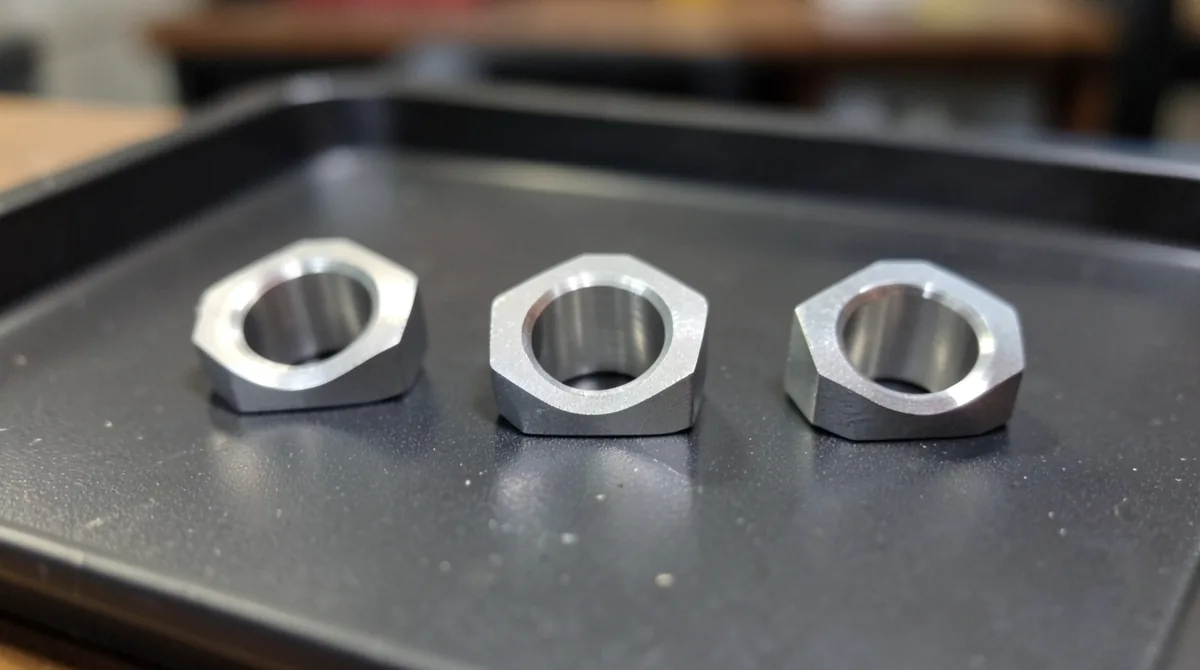
A shop built for short-run work treats small quantities as the core business rather than an interruption. Programming, setup, and inspection get planned around frequent changeovers.
For buyers, that opens up several options:
- Order a single prototype and test it before committing to more.
- Iterate the design in small lots rather than carrying obsolete inventory.
- Bridge the gap between prototype and production while larger tooling is decided.
- Replace one worn part without buying spares nobody needs.
One trade-off stays honest. No minimum does not mean low per-piece pricing. A single part still carries its full setup, so the unit cost at quantity one is higher than at quantity fifty. What changes is access: the buyer can get the part at all.
Small Manufacturers Buy Small Lots
Many of the buyers who need small quantities are small companies themselves. In a 2022 post, the NIST Manufacturing Extension Partnership reported that nearly 99 percent of U.S. manufacturing establishments have fewer than 500 employees, and around 91 percent have fewer than 100. Those firms build specialized equipment, fixtures, and components in modest volumes, and they depend on suppliers that quote modest volumes.
How to Order Small Quantities Well
Buyers can keep small orders efficient with a few habits:
- Ask for pricing at two or three quantities to see where the setup cost levels off.
- Combine related parts into one order when they share material or setups.
- Keep revision control tight so a small batch matches the latest print.
- Ask whether programs and fixtures stay on file for repeat orders.
- Decide early whether the part needs a coating, because finishing options for CNC machined parts can add their own lot charges.
When a part proves itself, the next question is volume. Planning the move from prototype to production CNC machining early keeps the small-batch setup useful at larger quantities.
At EGM Manufacturing, there are no volume minimums. The shop runs anything from one prototype through 1,000 or more units in short run production and takes on the jobs other shops decline because the quantity is too small.
Frequently Asked Questions About No Minimum Order CNC Machining
01What does no minimum order mean in CNC machining?
No minimum order means a machine shop will quote and produce any quantity, including a single part. It does not set a minimum piece count or minimum dollar value. EGM Manufacturing in Sunrise, Florida, has no volume minimums and machines anything from one prototype through 1,000 or more units.
02Why do some machine shops require a minimum order?
Every machined part carries fixed setup costs for programming, fixturing, first-part proving, and inspection. Those costs stay about the same whether the order is five parts or five hundred. Shops focused on long production runs set minimums so small orders do not take machine time away from larger jobs.
03Is one CNC part more expensive per piece than a batch?
Yes. A single part carries the full cost of programming, setup, and inspection, while a batch spreads that cost across every piece. Ordering a few extra parts often lowers the unit price noticeably. Asking for quotes at two or three quantities shows where the price per piece starts to level off.
04Can I order a prototype and then a small batch from the same shop?
Yes. Using the same shop for the prototype and the first small batch keeps programs, fixtures, and inspection plans in one place, so the batch starts from proven setups. It also keeps one quality record for the part. Buyers should confirm the shop keeps programs and fixtures on file between orders.
05Who does no minimum order CNC machining in South Florida?
EGM Manufacturing in Sunrise, Florida, provides CNC milling, turning, prototyping, and short-run production with no volume minimums. The shop is ISO 9001:2015 certified, AS9100 certified, and ITAR registered, and it accepts single-piece prototype orders as well as short runs of 10 to 1,000 units.
EGM Manufacturing: Precision CNC Machining in Sunrise, Florida
EGM Manufacturing has machined precision parts in Sunrise, Florida since 2005. The shop is ISO 9001:2015 certified, AS9100 certified, and ITAR registered, with no volume minimums — one prototype or a thousand pieces.
Our Services Include:
- Short Run Production — 10 to 1,000 units with repeat order tooling and in-house finishing
- CNC Prototyping — First-article inspection, DFM feedback, and reverse engineering from a drawing or a sample
Have a part other shops won’t quote? Send EGM the print with your material, tolerance, and quantity.
Works Cited
- Blum, Megean, and Nico Thomas. “Manufacturers Identify Top Challenges They Expect to Face.” Manufacturing Innovation Blog, National Institute of Standards and Technology, 14 Oct. 2022, www.nist.gov/blogs/manufacturing-innovation-blog/manufacturers-identify-top-challenges-they-expect-face.
- U.S. Census Bureau. “Business Formation Statistics, August 2026.” U.S. Department of Commerce, 11 Sept. 2026, www.census.gov/econ/bfs/pdf/bfs_current.pdf.