
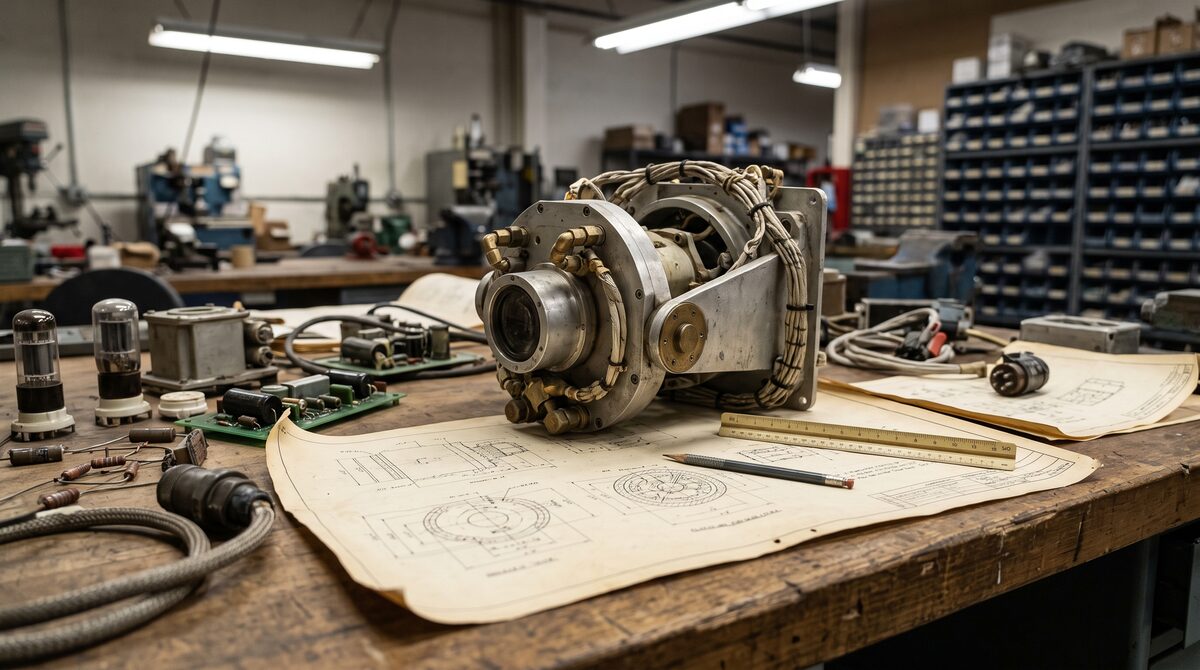
In January 2026, the Defense Standardization Program Office published an updated edition of SD-22, the guidebook that tells program managers what to do when the company that made a part stops making it.
The acronym for the problem is DMSMS: Diminishing Manufacturing Sources and Material Shortages. It covers the loss, or the coming loss, of the manufacturer or supplier of an item or a raw material. A supplier ends production. A supplier drops support for something still on its catalog. A raw material stops being available at any price. The Department of Defense runs a dedicated DMSMS program because those failures hit readiness, schedule, and cost at the same time, and because they are permanent rather than cyclical.
For a machine shop, none of this is abstract. DMSMS is a category of work, and it arrives in quantities of twenty.
Fleet age is the engine
An aircraft, a vehicle, or a shipboard system designed thirty years ago is often still in service, and often scheduled to stay there. The airframe outlives its supply chain by a wide margin.
The company that machined a particular housing in 1998 may have been acquired, moved into a different market, or closed. The tooling was scrapped. The engineer who knew the part retired. Nothing about the requirement changed, and every part of the ability to fill it did.
This is the mechanism behind the four forces described in our pillar article on disappearing minimum order quantities, and it is the one that compounds fastest. Every additional year of fleet life converts more of the original supplier base into a gap. Obsolescence is not a risk that gets managed down over time. Left alone, it only accumulates.
The last-time buy rarely lasts
The standard defense against obsolescence is the last-time buy. A supplier announces it is ending production, the program calculates how many units it needs for the remaining service life, and it buys them all at once.
The math depends on a forecast, and the forecast is usually wrong in the same direction. Service life gets extended. A modification changes the failure rate. Consumption runs ahead of the model. The stock that was meant to cover twenty years covers nine.
Storage adds its own attrition. Elastomers age out. Coatings degrade. Shelf-life items expire while sitting on a shelf, which is the failure the storage paperwork exists to catch.
What is left when the bunker runs dry is a requirement for a small number of certified parts with no current source. That is the point where low volume production machining stops being a procurement preference and becomes the only path available.
When the drawing is gone
The cleanest version of this problem is a program that holds a complete technical data package, releases it, and asks a qualified shop to quote.
The common version is messier. Drawings were never delivered, because the original contract bought parts rather than data rights. Drawings exist on paper, in a revision state nobody can confirm. Drawings exist as a scan of a scan, with the tolerance block illegible.
Data rights are the quiet driver here. A contract that bought parts rather than the technical data package leaves the program with no ability to hand a drawing to a second source, even when the drawing physically exists. A procurement decision made decades ago is what turns a routine reorder into a reverse engineering project.
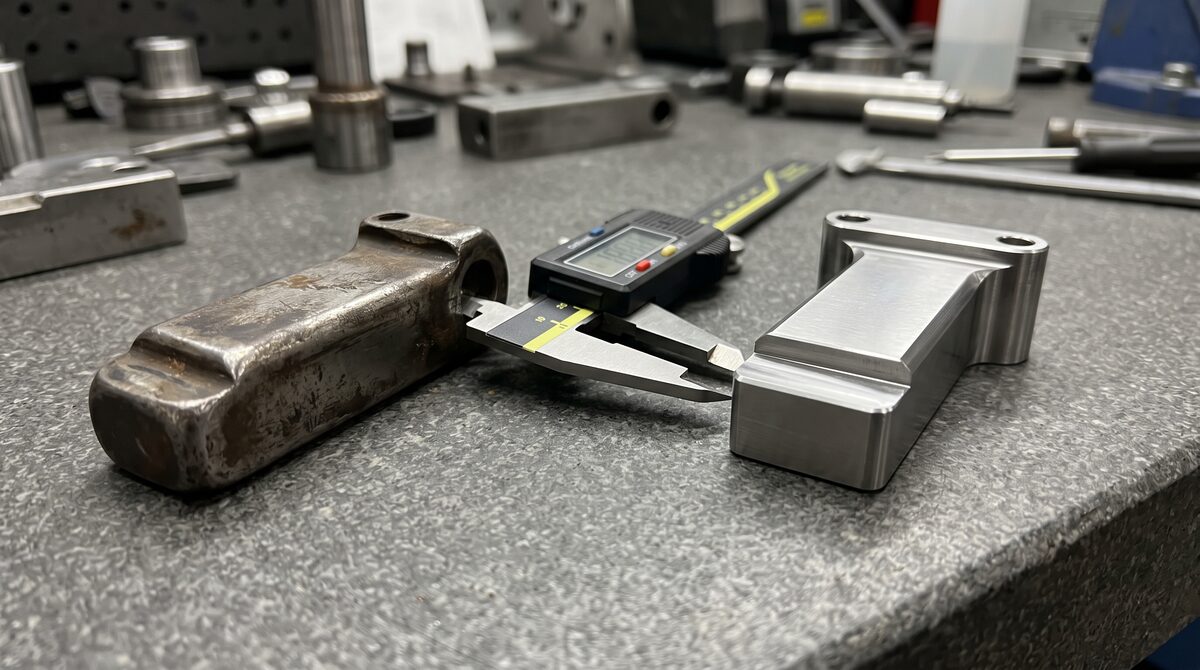
What the program does have is a part. Sometimes a used one pulled during teardown, sometimes the last good unit from stores.
Reverse engineering closes that gap. A shop measures the existing component, reconstructs the geometry as a model, and works with the program to re-establish the material, the finish, and the feature tolerances the part actually needs rather than the ones an unreadable drawing implies. That reconstruction is engineering work, not scanning, and it is the reason CNC prototyping capability matters to sustainment buyers who have no prototype to build.
Why these orders stay small and irregular
Obsolescence demand does not behave like production demand, and buyers who treat it that way get quoted badly.
The quantities track failures rather than build rates. A depot needs enough units to clear the current backlog and hold a reasonable margin. Twenty. Fifty. Occasionally a few hundred when a fleet-wide inspection turns something up.
The timing tracks discovery. An obsolescence issue surfaces when a requisition fails, not on a schedule anyone set in advance. The order is urgent by the time it is written, because the part was needed before anyone knew there was no source.
The repeat is unpredictable. The same item may come back in fourteen months or in six years, at a different quantity, against the same drawing package. A supplier that stores programs, fixtures, and run records can serve the second order at a fraction of the first setup. A supplier that starts over charges for starting over.
What it takes to serve obsolescence work
Small quantity alone does not qualify a shop for this. The combination is what qualifies it.
Quality system that does not scale down. AS9100 governs the process, not the batch size. A lot of twenty needs the same documented controls, material certifications, dimensional reports, and traceability as a lot of two thousand. Ask a supplier directly whether small batches run under the same system.
Export-control standing. Sustainment work on defense systems frequently involves controlled technical data. ITAR registration is a prerequisite for handling it, and it is separate from any quality certification. A shop can hold AS9100 without being registered, and buyers should confirm both rather than assuming one implies the other.
Engineering input, not just spindle time. When the data package is incomplete, someone has to reconstruct intent from a physical sample and flag what cannot be held on the geometry as drawn.
No volume minimum. A five hundred piece floor makes a shop unavailable for the entire category, whatever else it can do. Shops that quote a small lot reluctantly tend to price it that way, which is a different problem from declining outright and produces the same result for the buyer.
Those four together are uncommon, which is why obsolescence buyers tend to keep a short list. The tighter version of the same supplier problem, at quantities between fifty and five hundred, runs through our article on the qualification gap.
The economics nobody budgets for
An obsolete part with no source is not a line item that stays flat. It escalates.
The first response is a workaround. The second is cannibalization from a lower-priority unit. The third is a system that cannot be returned to service because one machined component has no supplier and no data package.
The cost also lands in the wrong budget. Obsolescence surfaces during operations and support, long after the office that made the original sourcing decision has moved on. Nobody line-items it in advance, so it competes with funded work for attention at the moment it is least convenient to raise.
Set against that, the cost of a twenty piece run at low volume production machining rates is small, and the schedule risk of finding a qualified shop late is the part that actually hurts. Programs that identify obsolescence early have options. Programs that find it at the requisition counter have one.
Frequently Asked Questions About Low Volume Production Machining for Obsolete Parts
01What does DMSMS stand for?
DMSMS is Diminishing Manufacturing Sources and Material Shortages. It describes the loss, or impending loss, of a manufacturer or supplier of an item or raw material. The Department of Defense manages it as a formal program because obsolescence affects readiness, schedule, and cost across long-lived systems simultaneously.
02Why can a part become unavailable if the design has not changed?
Availability depends on the supplier, not the design. Companies exit markets, get acquired, scrap tooling, or discontinue low-margin items. Raw materials also disappear. The requirement stays valid while the source vanishes, which is what makes obsolescence a supply problem rather than an engineering problem.
03Can a machine shop make a part without the original drawing?
Often yes, through reverse engineering. A shop measures an existing component, builds a model from those measurements, and works with the customer to confirm material, finish, and tolerances. The result is a documented package the program can order against, which many legacy items never had to begin with.
04How small are typical obsolescence orders?
Small and irregular. Quantities track failures rather than production rates, so twenty or fifty units is common, with occasional larger batches after a fleet inspection. Repeat orders arrive on no fixed schedule. Suppliers who store tooling and run records handle that pattern far more efficiently.
05Does AS9100 apply to a batch of twenty parts?
Yes. AS9100 certifies the quality management system rather than any specific order size. A certified shop runs a small lot under the same documented process, with material certifications, dimensional reports, and traceability on every batch. Confirm that a supplier applies the identical system to low volume work.
EGM Manufacturing: Parts That No Longer Have a Source
EGM Manufacturing has machined precision parts in Sunrise, Florida since 2005. The shop is ISO 9001:2015 certified, AS9100 certified, and ITAR registered, with no volume minimums. Ten parts or a thousand, run under the same quality system, with material certifications, dimensional reports, and full traceability on every batch.
Our Services Include:
- CNC Prototyping: Reverse engineering from a drawing or an existing part, first-article inspection, and DFM feedback
- Short Run Production: 10 to 1,000 units with repeat order tooling stored between runs and in-house finishing
Have a part with no current supplier? Send EGM the print with your material, tolerance, and quantity. If there is no print, send the part.
Works Cited
- “Diminishing Manufacturing Sources and Material Shortages (DMSMS).” Defense Standardization Program Office, U.S. Department of Defense, www.dsp.dla.mil/Programs/DMSMS/. Accessed 25 Aug. 2026.