
An engineer with a new design usually asks one question first. How fast can a machine shop turn this model into a part? The honest answer is that it depends. Most of what it depends on is settled before the part reaches a spindle. Fast CNC prototyping is less about cutting speed and more about how few obstacles stand between the print and the first chip.
Why Fast CNC Prototyping Is Harder to Find in 2026
Shop capacity is tighter than it was a year ago. According to the Federal Reserve’s industrial production and capacity utilization release of September 18, 2026, covers fabricated metal products, the industry group that includes machine shops. Capacity utilization in that group stood at 78.3 percent in August 2026. That is up from 76.1 percent in the fourth quarter of 2025 and close to the group’s long-run average.
Demand is coming from the sectors that buy the most prototypes. The same release shows defense and space equipment output 6.1 percent above its level a year earlier. Business equipment output rose 7.1 percent.
A shop running near its normal ceiling has less slack for a one-off job. That is why the queue now matters as much as the machining.
What Actually Sets a Prototype Timeline
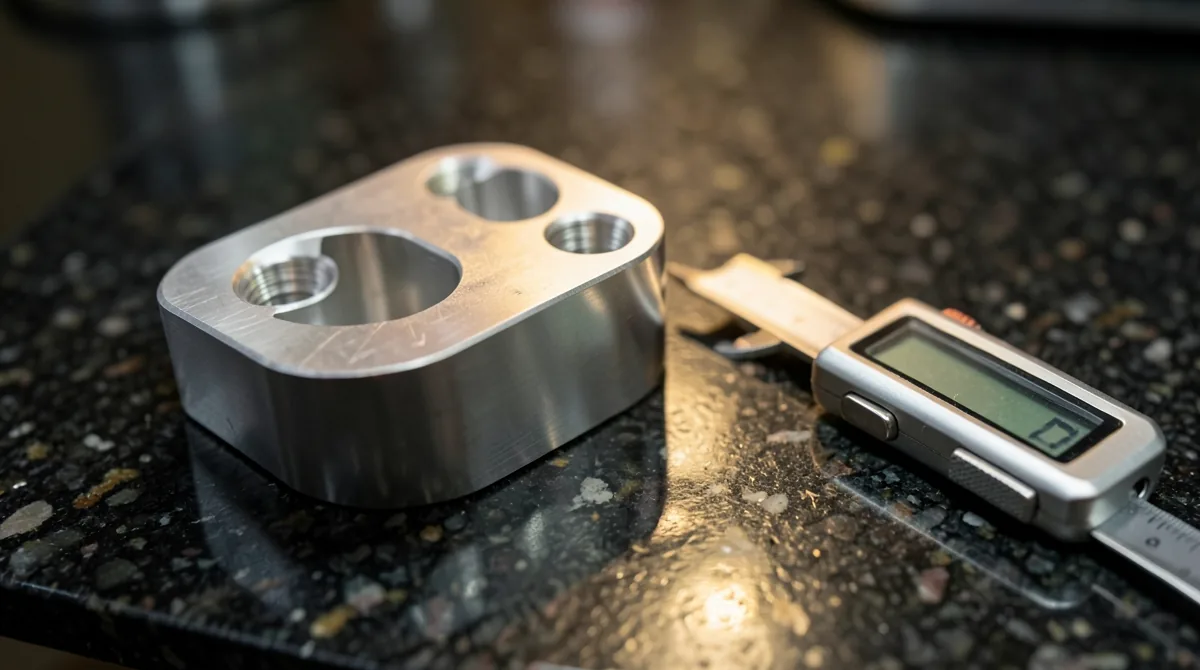
Five factors decide how long a first part takes, and each one can add days on its own.
The print. A complete drawing with tolerances, material, and finish callouts moves straight to programming. A model with missing callouts starts a round of emails first. Engineers who get design for manufacturability feedback on a CNC part before release often shorten that loop. The shop flags problem features before anyone programs them.
Material. Common grades of aluminum and stainless steel are usually easy to source. Specialty alloys, certified material with mill test reports, and unusual bar sizes take longer. Some arrive more slowly than the part takes to machine.
Setups. Each time an operator unclamps and refixtures a part, the job picks up programming, fixturing, and inspection time. A part with features on five faces might need three setups on a 3-axis mill but one on a 5-axis machine. Fewer setups mean fewer handoffs and fewer chances for a stacked error.
Tolerances. Tight tolerances slow feed rates, add finishing passes, and demand more inspection time. If a tolerance matters only on a mating bore, put it on that bore rather than in the title block.
Finishing and inspection. Anodizing, plating, and heat treatment often go to outside vendors, and each vendor has its own queue. First article inspection adds time too, but it catches a bad feature before a second batch repeats it.
The Queue and the Workforce Behind It
A machine runs only as fast as the people who program, set up, and inspect it. The Bureau of Labor Statistics counted about 288,300 machinist jobs in 2025. It projects about 30,400 openings for machinists and tool and die makers each year through 2035. All of those openings come from replacing workers who retire or change careers, not from growth.
That matters for prototypes in particular. BLS notes that precision machinists often produce small batches or single items. Small-batch work leans on experienced machinists for setup and programming, so a short-staffed shop tends to push it down the list.
The Second Prototype Is Where Time Is Won
Few designs survive the first article unchanged. A second revision moves faster when the shop keeps the original program, fixture, and inspection plan on file. Only the changed features need new work. A marked-up drawing with a clear revision block turns a full reprogram into an edit. That difference compounds across a program with four or five iterations.
How Engineers Can Shorten Their Own Timeline
Most delays are avoidable, and the buyer controls several of them.
- Send a complete package: 3D model, 2D drawing, material, quantity, and finish.
- Mark the features that matter, and tolerance only what needs it.
- Choose a stocked material for the first iteration when the design allows it.
- Ask whether finishing can wait until a later revision.
- Ask how many setups the shop plans, and whether a multi-axis machine reduces them.
Some prototypes start without a drawing at all. A worn or obsolete component can serve as the reference. In that case, reverse engineering a part for CNC machining adds a measurement and modeling step before any cutting begins. Build that step into the schedule.
In short, fast CNC prototyping comes from a clean handoff. A shop structured for prototype work can move quickly, but only as quickly as the print, the material, and the finish allow. At EGM Manufacturing, the CNC prototyping workflow is built around prototype and short-run jobs. Once the print, material, and finish are settled, most prototype work moves in days rather than weeks.
Frequently Asked Questions About Fast CNC Prototyping
01How fast can I get a CNC machined prototype?
A CNC machined prototype can move in days rather than weeks when the print is complete, the material is stocked, and setups are few. Specialty alloys, outside finishing such as anodizing or plating, and missing drawing callouts are common reasons a prototype timeline stretches longer. Each adds time before or after the machining itself.
02What slows down a CNC prototype the most?
Incomplete prints slow a CNC prototype more than anything else. Missing tolerances, material callouts, or finish notes trigger questions before programming can start. Hard-to-source material and outside finishing vendors come next. The machining itself is often the shortest step in the timeline, especially on a part that needs only one or two setups.
03Does 5-axis machining make prototypes faster?
5-axis machining can shorten a prototype timeline when a part has features on several faces. Reaching those features in one setup removes the refixturing, re-indicating, and extra inspection a 3-axis mill needs between setups. On a simple part with features on one or two faces, a 3-axis mill is often just as fast.
04Should I skip finishing on a first prototype?
Skipping finishing on a first prototype often saves time when the part is for fit checks or form testing. Anodizing, plating, and heat treatment usually go to outside vendors with their own queues. If the prototype must prove corrosion resistance, wear performance, or appearance, the finish belongs on the first article.
05Does a CNC prototype need first article inspection?
Many CNC prototypes do, especially for aerospace, medical, or production-intent programs. A first article inspection checks the first machined part against every dimension and note on the print before more parts are made. It catches a bad feature before a batch repeats it. EGM Manufacturing in Sunrise, Florida, includes first-article inspection in its CNC prototyping service.
EGM Manufacturing: Precision CNC Machining in Sunrise, Florida
EGM Manufacturing has machined precision parts in Sunrise, Florida since 2005. The shop is ISO 9001:2015 certified, AS9100 certified, and ITAR registered, with no volume minimums — one prototype or a thousand pieces.
Our Services Include:
- CNC Prototyping — First-article inspection, DFM feedback, and reverse engineering from a drawing or a sample
- Short Run Production — 10 to 1,000 units with repeat order tooling and in-house finishing
Have a part other shops won’t quote? Send EGM the print with your material, tolerance, and quantity.
Works Cited
- Board of Governors of the Federal Reserve System. “Industrial Production and Capacity Utilization — G.17.” Federal Reserve, 18 Sept. 2026, www.federalreserve.gov/releases/g17/current/g17.pdf.
- U.S. Bureau of Labor Statistics. “Machinists and Tool and Die Makers.” Occupational Outlook Handbook, U.S. Department of Labor, 27 Aug. 2026, www.bls.gov/ooh/production/machinists-and-tool-and-die-makers.htm.