
A quote tells an engineer what a part costs and roughly when it can ship. A design for manufacturability CNC review answers an earlier question: is the part as drawn the part worth making? The same problem found after first article costs a revision, a reprogram, and a second round of material.
Why DFM Feedback Carries More Weight in 2026
Regulated buyers are documenting design decisions more closely this year. The FDA’s Quality Management System Regulation took effect on February 2, 2026, and it incorporates ISO 13485:2016 by reference. The FDA notes that devices built under an investigational device exemption still fall under design and development requirements, so design controls reach into the investigational stage, not only commercial production.
In a controlled design system, each late change carries review, approval, and records. Catching a manufacturability problem before release keeps that change count down. It also protects the schedule, because a redesign resets every factor covered in what sets a fast CNC prototyping timeline.
What a Design for Manufacturability CNC Review Checks
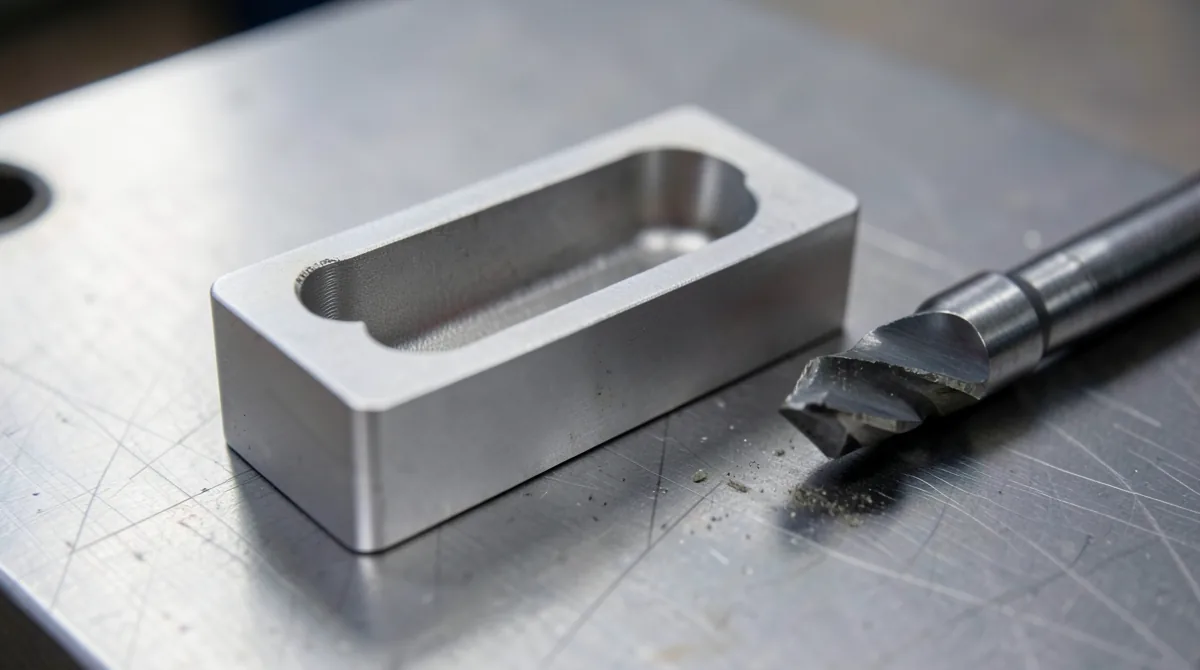
Internal corners and tool reach. A rotating cutter leaves a radius in every internal corner. A sharp corner on the model either needs a larger radius, a relief, or a slower secondary process. Deep, narrow pockets need long, thin tools that deflect and chatter, which costs time and surface finish.
Thin walls and floors. Thin sections vibrate under cutting load and can move when the part is unclamped. A slightly thicker wall or a support rib often costs little in weight and saves a lot in scrap.
Holes and threads. Standard drill sizes and common thread specifications use tooling already in the carousel. Odd diameters, flat-bottom blind holes, and thread depths well past what the fastener needs all add operations.
Tolerances and datums. A blanket title-block tolerance forces tight machining on features that do not need it. Reviewers look for tolerances applied only where function demands them, and for a datum scheme that matches how the part will be held and inspected.
Setups and part orientation. Features on many faces, undercuts, and angled holes raise the setup count. Sometimes a small change to a hole angle or a feature location lets the part finish in fewer setups.
Material and finish. Some alloys machine far more slowly than others with similar properties. Coatings such as anodizing add thickness, so a reviewer checks whether tight dimensions apply before or after finish and whether areas need masking.
Inspection access. A feature that a probe or gauge cannot reach cannot be verified, so reviewers check measurability too.
Drawings, Models, and the Data Gap
Many DFM questions start with the data package itself. Research from the National Institute of Standards and Technology describes how design owners have traditionally sent suppliers 2D drawings, sometimes with a 3D geometry model, and how suppliers then build their own CAM and inspection programs from that data.
For a shop reviewing a prototype, the most common snag is simpler. The model and the drawing disagree, and nobody has said which one governs. A note on the drawing that settles that question saves a round of emails.
DFM on Parts With No Print at All
Legacy and obsolete components often arrive as a worn sample rather than a drawing. In those cases, reverse engineering a part for CNC machining produces the model, and the DFM review applies to that new model. It is also a chance to fix features that made the original part hard to machine, as long as the change keeps the fit and function the assembly depends on.
How to Get Useful DFM Feedback
Engineers get better feedback when the shop understands what the part has to do.
- Send a 3D model and a fully dimensioned 2D drawing together.
- Mark the features that are critical to function.
- Share the prototype quantity and the expected production quantity.
- Ask for each proposed change with a short reason attached.
At EGM Manufacturing, process engineers review CNC prototyping packages for manufacturability before machining starts. When a feature is hard, costly, or risky to hold, the team flags it with a proposed change that keeps the design intent, and the design engineer decides.
Frequently Asked Questions About Design for Manufacturability CNC Feedback
01What is DFM feedback in CNC machining?
DFM feedback in CNC machining is a review of a part design by the people who will machine it. The reviewer flags features that are hard, slow, or risky to cut, such as sharp internal corners, thin walls, or unneeded tight tolerances, and proposes changes that keep the part’s function while making it easier to produce.
02When should I ask a machine shop for DFM feedback?
Ask for DFM feedback before the design is released, ideally when the model is complete but the drawing is still open to change. At that stage a corner radius or a tolerance adjustment costs only an edit. After release, the same change may need a formal revision, new approvals, and a second prototype run.
03Does DFM feedback change my design intent?
Good DFM feedback should not change design intent. A reviewer proposes changes, such as adding a corner radius or loosening a non-critical tolerance, and explains why. The design engineer keeps the final decision. If a suggested change would affect fit, strength, or function, the engineer can reject it and keep the original feature.
04What files should I send for a DFM review?
Send a 3D model in a neutral format such as STEP, plus a 2D drawing showing tolerances, material, finish, and critical features. EGM Manufacturing in Sunrise, Florida, accepts STEP, IGES, SolidWorks, DWG, DXF, and PDF files through its quote form. A note stating which document governs if they disagree saves time.
05What features make a CNC part expensive to machine?
Deep narrow pockets, sharp internal corners, thin walls, and tight tolerances applied to every feature all add machining time. Features spread across many faces add setups, and odd hole sizes, deep threads, and hard-to-machine alloys add more. A DFM review flags these features so engineers can decide which ones the design needs.
EGM Manufacturing: Precision CNC Machining in Sunrise, Florida
EGM Manufacturing has machined precision parts in Sunrise, Florida since 2005. The shop is ISO 9001:2015 certified, AS9100 certified, and ITAR registered, with no volume minimums — one prototype or a thousand pieces.
Our Services Include:
- CNC Prototyping — First-article inspection, DFM feedback, and reverse engineering from a drawing or a sample
- Short Run Production — 10 to 1,000 units with repeat order tooling and in-house finishing
Have a part other shops won’t quote? Send EGM the print with your material, tolerance, and quantity.
Works Cited
- Trainer, Asa, et al. “Gaps Analysis of Integrating Product Design, Manufacturing, and Quality Data in the Supply Chain Using Model-Based Definition.” National Institute of Standards and Technology, 28 June 2016, www.nist.gov/publications/gaps-analysis-integrating-product-design-manufacturing-and-quality-data-supply-chain.
- U.S. Food and Drug Administration. “Quality Management System Regulation (QMSR).” FDA, 2 Feb. 2026, www.fda.gov/medical-devices/postmarket-requirements-devices/quality-management-system-regulation-qmsr.
- This article is general industry information and is not a substitute for FDA guidance, the applicable standard, or a qualified engineer’s assessment of your specific application.